A Day in Soweto
As per my previous blog post, I've decided to make a conscious effort to see more of Johannesburg beyond the neighbourhoods that have become our own little corner of it. Joburg is an incredibly diverse city, and it seemed a shame to spend our time here experiencing only the parts that were familiar or easy to reach. Soweto was an obvious place to start. Famous around the world as the home of Nelson Mandela and Desmond Tutu, and central to the history of the struggle against apartheid, it is one of those places I had heard about long before I ever set foot in Johannesburg.

I had previously explored the Ponte Tower in Hillbrow with Dlala Nje, I already knew they were a good way to see a different side of the city, so when I decided it was finally time to visit Soweto, I knew who I wanted to take me.
We were greeted by our guide, Martin, an enigmatic man who would spend the next few hours showing us around Soweto. We began on Vilakazi Street, probably the most famous street in the township and, today, one of its most vibrant and affluent. It is also the only street in the world to have been home to two Nobel Peace Prize winners: Nelson Mandela and Desmond Tutu. Mandela lived here with Winnie Mandela, while Tutu's former home sits just a few doors away.
It is hard to imagine a street with such a complicated history becoming quite such a polished tourist destination, but Vilakazi Street has undergone a remarkable transformation. Martin talked us through its rise as one of Soweto's main attractions, and how increasing prosperity among Black South Africans following the end of apartheid has allowed more residents to invest in their homes and businesses and, importantly, back into the community around them. Today, the street is lined with restaurants, cafés, galleries and smart homes, and some of the property prices reflect just how far it has come. One house, Martin told us, was on the market for around R4 million (roughly £182,000).
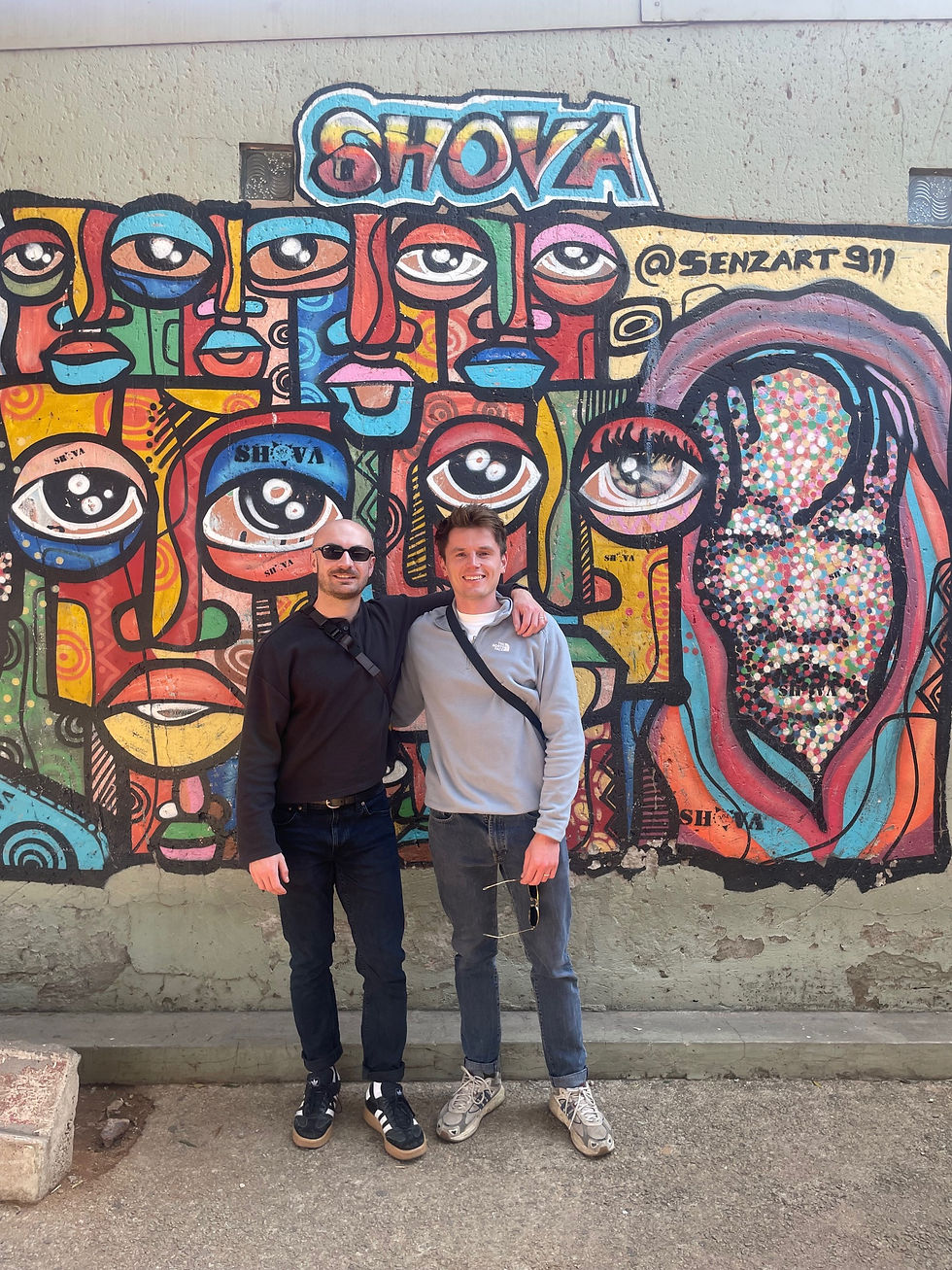
What surprised me most was how little it looked like the Soweto I had, somewhat naively, conjured in my head. The streets were clean and well maintained, the pavements surprisingly good, and the houses far more substantial than I had expected. In fact, as we walked down Vilakazi Street, I couldn't help noticing that the pavements looked considerably better than some of those on the streets around our home in Illovo. It was a small but telling reminder that the picture you build of a place from a distance is rarely the whole story.
From Vilakazi Street, we walked towards an informal settlement on the edge of an industrial area, where rows of corrugated-iron shacks sit alongside the railway tracks. This was the part of the tour I found most difficult. I had been hoping we might simply see the settlement from a distance, rather than walk through it, and as we entered I couldn't shake the feeling that there was something uncomfortable about being led through people's homes as a visitor. Where does genuine curiosity end and poverty tourism begin? I didn't really know the answer.
The reality of life here is stark. Some residents rely on makeshift electricity connections running from the nearby railway infrastructure, with cables strung precariously around the settlement. Martin pointed out just how dangerous this can be, particularly for children, who play around areas where live wires are exposed. It was a particularly sobering thing to see after spending the morning on Vilakazi Street, where some of Soweto's homes sell for millions of rand.
Martin also told us that, just the previous week, a family had died after bringing a coal fire into their shack during Johannesburg's recent cold snap. The fumes had built up inside the small space while they slept. It was a devastating reminder that the winter cold we complain about in our own homes is a very different proposition when your home is a corrugated-iron shack with no proper heating or insulation.
I also took the opportunity to ask Martin about something that has been difficult to ignore in South Africa recently: attitudes towards foreign residents. Johannesburg and other parts of the country have seen periodic anti-immigration protests, particularly directed at people from elsewhere in Africa who come to South Africa in search of work. I was curious whether those tensions were felt as strongly in Soweto.
According to Martin, they are less pronounced here. Soweto's own history of migration and its mix of backgrounds, he explained, means that residents can be more understanding of people who have come from elsewhere looking for a better life. And, walking through the settlement, it certainly didn't feel as though we were unwelcome. People called out greetings as we passed, children wanted to say hello and there was a genuine warmth towards us as visitors.
If anything, what struck me most was how proud people seemed to be of Soweto. Even in the parts of the township where life is undeniably difficult, there was no sense that residents wanted us to see only the hardship. They wanted us to see their home.
By lunchtime, we had worked up an appetite, and Martin took us to a traditional shebeen for lunch. We were served a wonderfully uncomplicated South African meal of pap with meat and gravy - the kind of food that doesn't need much explaining and is all the better for it.
Our lunch came with some entertainment, too. A man arrived carrying a guitar and started singing, and he was genuinely brilliant, so naturally we gave him a tip when he finished.
Then, just as our food arrived, he came back over and asked if he could have a taste.
I was slightly baffled. I don't think anyone has ever asked to eat off my plate quite so casually before, but who was I to say no? So he helped himself, and Martin immediately told him off - for the fairly important reason that he hadn't washed his hands. Looking back, perhaps I should have thought that one through. At the time, though, it was mostly just very funny. And probably one of the more memorable lunch experiences I've had in Johannesburg.
From here, we followed the Hector Pieterson Trail, something I was particularly keen to do after seeing Rise 76 at the Market Theatre earlier this year. I’ll spare you another detailed retelling of the uprising I’ve written about Rise 76 here.

We stopped at Conflict Corner, where Martin talked us through the events of 16 June 1976 and the student protests that would become one of the defining moments in the struggle against apartheid. Thousands of schoolchildren took to the streets that morning to protest the compulsory use of Afrikaans as a language of instruction. What began as a peaceful demonstration was met with police violence, and the shootings that followed left hundreds dead and injured.
Standing there, it was difficult not to think about the photographs that made the events of that day impossible for the outside world to ignore. Martin told us more about Sam Nzima, the photographer who captured the now-famous image of 12-year-old Hector Pieterson being carried through the streets by fellow student Mbuyisa Makhubu, with Hector's sister Antoinette running alongside them. The photograph was published in The World and rapidly circulated around the world, becoming one of the defining images of apartheid-era South Africa.
What I hadn't known was what Nzima had done to protect the photographs. After taking the images, he removed the film containing the crucial shots and concealed it on his person before the police confiscated his camera. He replaced it with a fresh roll, which the police took and destroyed, unaware that the images they were looking for were safely hidden away. The surviving film ultimately allowed the photograph to be published, giving the world an unfiltered glimpse of what had happened in Soweto that day.
It was one thing to have seen that photograph countless times; it was another to stand on the streets where it was taken. The history of Soweto isn't confined to museums or memorials, it happened on these streets, outside these houses, in places where ordinary people still live their lives every day.
Our tour finished outside the Hector Pieterson Museum, where we didn't go inside but spent some time looking at the memorials surrounding it. After several hours of hearing about some of the most painful chapters in South Africa's history, it was a suitably reflective place to end.
One thing I couldn't help noticing was the contrast between the museum and the school immediately next door. The museum is an impressive, substantial building, while the school looked comparatively modest. It left me wondering about the balance between preserving the history of South Africa's education struggles and investing in the education of the children living here today. I don't have an answer to that, and perhaps it is an unfair comparison based on appearances alone, but it was one of those observations that stayed with me after we left.
Overall, it had been a heavy day, but not a sombre one. There had been plenty of laughter, good food, music, unexpected conversations and the simple pleasure of being shown around somewhere by someone who clearly knew and cared about his home. More than anything, the tour was a reminder of how little you can really understand about Johannesburg if you only experience the parts of it that are familiar to you.
Notes from 26° South.


Comments