The Western Cape with my sister
- jonathanjosephyoun
- Mar 13
- 4 min read
When my sister planned her visit to South Africa earlier this month, she decided she only wanted to spend 48 hours in Joburg. Who can blame her? After an 11 hour overnight flight from London in cattle class, you want to the juice to be worth the squeeze and visit the more refined, tourist friendly parts of this country. Sadly, Joburg isn't high up on many people's travel bucket list. But, after an excited welcome at arrivals at O.R. Tambo International Airport, I was determined to beat her expectations of the city and show Becks my version of Johannesburg - long lunches in the leafy suburbs, playing some exceptionally mediocre Padel in the sunshine purely for the vibes, good coffee, loud restaurants and the friendly Jozis. The weekend perfectly captured that strange energy the city runs on where everything feels chaotic but also very alive. By the end of her time in Johannesburg, she admitted she liked what she had seen of our new home. Joburg hadn't just been survivable, it had been fun.

Sticking to the itinerary, we flew from Joburg to Cape Town, which is when South Africa felt like it had changed outfits. Unlike ugly Joburg (see previous post), Cape Town arrives fully styled. Mountains in the backdrop that look photoshopped, ocean views, smooth(er) pavements, brunch menus, and an alarming number of very beautiful people wearing coordinated athleisure. Within our first days in the Mother City, we had done all the things you're supposed to do: a scenic hike up Lion's Head, frying ourselves on the beach, window shopping at overpriced farmers' markets and boozy dinners. It was a lovely time, undeniably, but Cape Town almost felt curated. This was my second visit (the first being a little over a year before) and even within that year the city feels much more like a postcard. A version of South Africa designed for European and American tourists with strong purchasing power and an unquenchable thirst for Chenin Blanc.

Having Becks with me made me notice things that I had stopped seeing. The small habits I've picked since living in Joburg, like always needing to be slightly on alert. When someone in Cape Town would ask us where we were from and I explained my situation, I realised I was now so used to automatically giving an explanation (or almost a justification) when I see their surprised reaction to me living in Joburg. I realised that my life suddenly needed context. Showing someone around your new home city forces you to narrate your own existence a little. This is especially true in a city like Joburg, where everyday life has its obvious challenges and I knew Becks would need some convincing before she liked it. But in Cape Town she loved it immediately. And, despite its over polished feeling, so did I. I felt like we had crossed an invisible border into what felt like a different country. What's not to love - sun, endless outdoor activities, beaches and a far more walkable city than Joburg.

After some quality time in CT, my husband joined us and we hit the road once again to spend a weekend in Stellenbosch - the heart of South Africa's wine country. Even compared to Cape Town, the shift when we arrived in Stellenbosch was noticeable. A pretty university town with tree lined streets and Dutch colonial architecture. It was beautiful, objectively. But it also felt very strange compared to the South Africa I've grown used to. It was very tidy, very organised and very white. What made it more jarring was the drive in. On the way there we passed stretches of informal settlements, corrugated metal roofs stacked along the roadside, before suddenly arriving in a town that look like it had been lifted straight out of a painting. The contrast was hard to ignore.
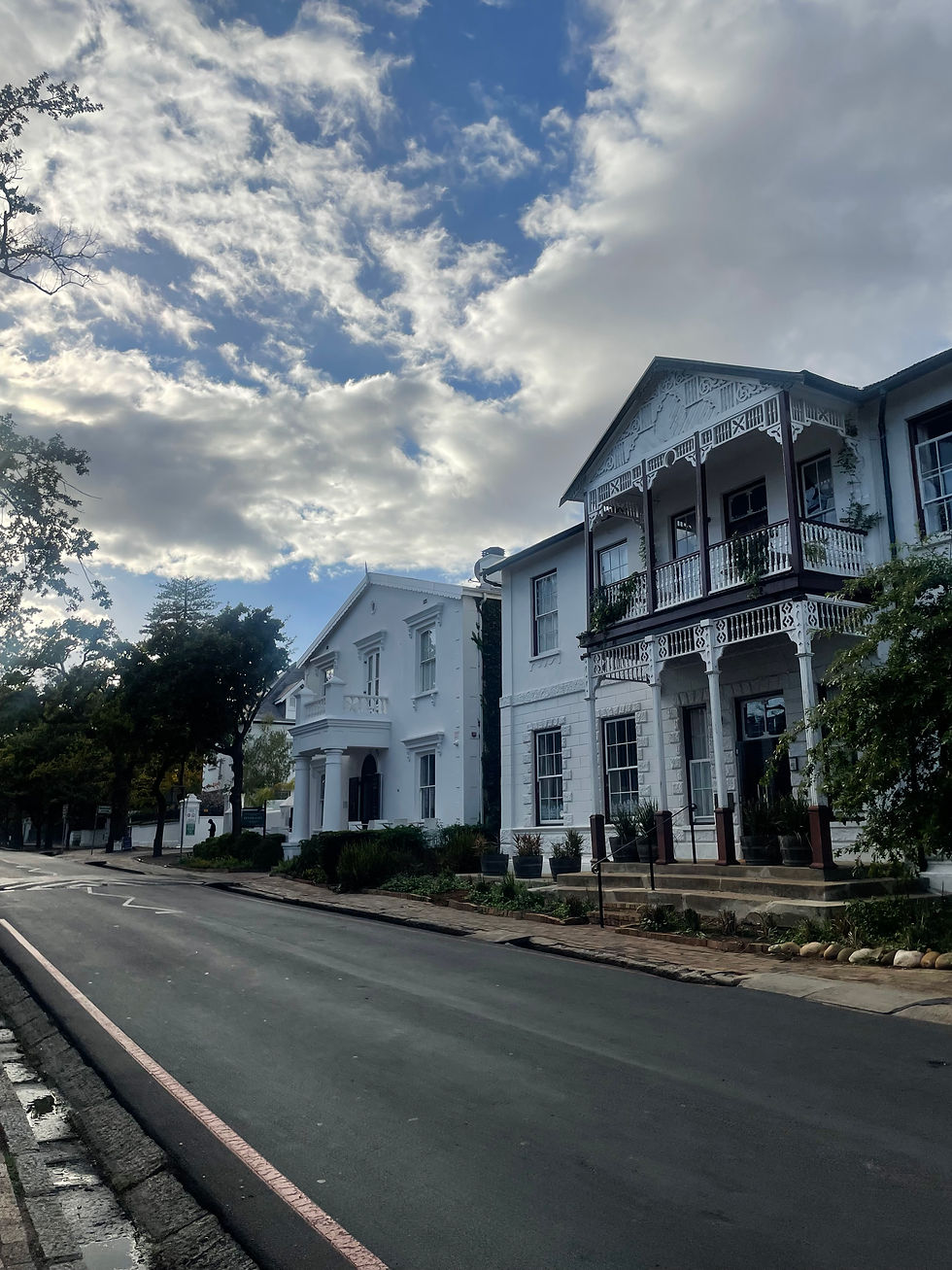
Part of that feeling comes from the history. Stellenbosch is one of the oldest European settlements in South Africa, founded in the late 1600s when the land in the valley was granted to Dutch settlers by colonial governors. Many of the vineyards around the town still trace their origins back to those early grants, and a lot of the estates remain in the hands of the long-established farming families whose names have been tied to the land for generations. Today the region is a mix of those old family estates, newer private owners and corporate wine companies, but the sense of generational farmland is still very present. Which makes the whole place feel both charming and uncomfortable at the same time.
Of course, we did what every visitor does there: we got on the Franschhoek wine tram. The wine tram is essentially a very cheerful system for transporting increasingly drunk tourists from vineyard to vineyard across the valley. Every 50 minutes or so the tram rolls in, depositing a group of people absolutely clucking for a fresh glass of shiveringly pale rosé and collecting another group. The routine becomes pleasantly repetitive: arrive at the vineyard, admire the view, down your generous pour of wine flight and then clamber back on the tram with a slightly louder version of the same group you arrived with. It's really good fun. Ridiculous, but fun. By the time we rolled back into Stellenbosch after a full afternoon on the wine tram, the town had a golden hour glow. Streets full of people drifting to their dinner reservations, slightly sunburnt and very relaxed. It was easy to see why people love it here.

And I really did have a great time in both Cape Town and Stellie. The breath taking natural beauty, good weather and even better food. It's the version of South Africa that they put in travel magazines, and for a few days its fun to lean into it. After spending a week with Becks in the Western Cape, we had a little emotional goodbye and I flew back to Johannesburg.
Somewhere between landing, getting into the car and driving through Joburg's hectic evening traffic, something odd happened. For the first time since moving here, Joburg didn't feel like the random place I just happened to be living. It felt familiar. The streets and the noise and the hazy sunset sky, was now something I recognised. For the first time, coming back here felt a little bit like coming home.
Notes from 26° South.


Comments